Published: June 1, 2024
Updated: May 5, 2026
My Opinion on Modern Feminism
Feminism began as a movement fighting for basic rights like voting, property ownership, and workplace equality. Over time, it evolved through several waves, each responding to the social challenges of its era. While early feminism focused on securing equal rights and opportunities for women, modern debates around the movement have become increasingly complex and controversial. Today, discussions about feminism often revolve around questions of identity, equality, and the direction the movement has taken. In this article, we’ll explore the history of feminism, the shifts that shaped it, and the ongoing debates surrounding modern feminist ideology.

Feminism is an idea rooted in the belief in political, economic, and cultural equality for women. The movement is often categorized into three distinct waves: the first wave, which fought for property rights and suffrage; the second wave, which addressed broader issues of equality and anti-discrimination; and the third wave, emerging in the 1990s, which responded to the second wave’s perceived focus on the experiences of white, straight women.
First Wave Feminism
Plato once argued that women have “natural capacities” equal to men, capable of governing and defending ancient Greece. However, not everyone shared his view. When the women of ancient Rome protested the Oppian Law, which limited their access to gold and other goods, Roman consul Marcus Porcius Cato exclaimed,
As soon as they begin to be your equals, they will have become your superiors!
Despite Cato’s objections, the law was eventually repealed.
The Seneca Falls Convention
The Seneca Falls Convention, held on July 19–20, 1848, in Seneca Falls, New York, was a breakthrough event in the women’s rights movement in the United States. Organized by activists Elizabeth Cady Stanton and Lucretia Mott, it addressed the inequalities faced by women, stemming from their exclusion at the World Anti-Slavery Convention in London in 1840.
The convention’s nucleus was the Declaration of Sentiments, written by Stanton. Modeled after the Declaration of Independence, it asserted that “all men and women are created equal” and listed grievances such as the denial of the right to vote and limited access to education and property rights. The declaration demanded equality across all areas of life and ignited debates that propelled the women’s rights movement forward.
Around 300 people attended, including Frederick Douglass, who supported the resolution for women’s suffrage. Despite initial ridicule from the press, the convention brought significant national attention to the women’s rights movement and is often seen as the formal start of the fight for gender equality in the U.S.
The Seneca Falls Convention inspired women’s rights conventions and laid the foundation for future activism, highlighting the power of collective action and persistent demand for social justice.
Women entered the workforce in greater numbers after the Great Depression, as many men lost their jobs and women had to take up lower-paying, stable jobs like housework, teaching, and secretarial roles.
During World War II, women filled roles in the military and industries traditionally held by men, making Rosie the Riveter a feminist icon.
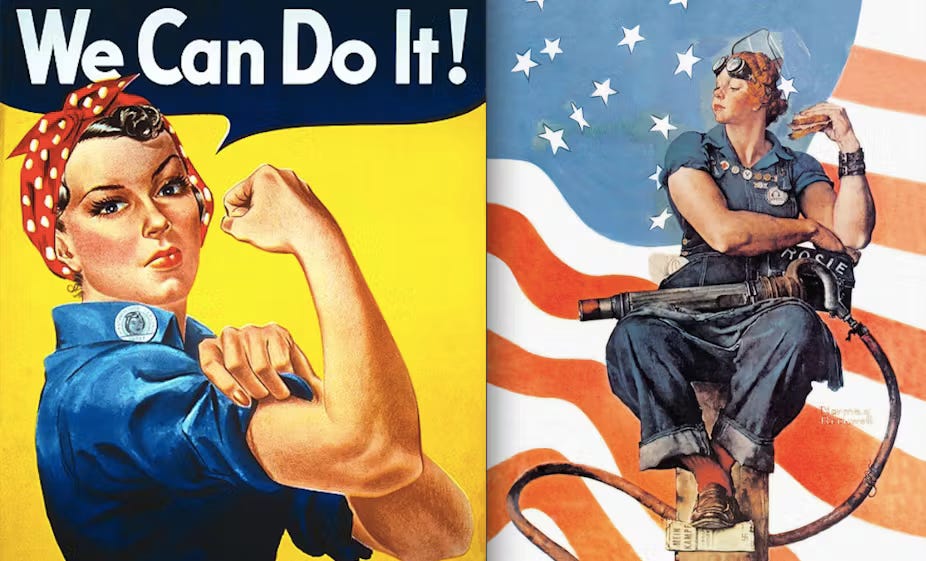
Rosie the Riveter — American Icon
Following the civil rights movement, women pushed for more workplace participation and equal pay, leading to the Equal Pay Act of 1963, an early effort to address pay inequality.
Second Wave Feminism
Cultural obstacles remained, and with the 1963 publication of The Feminine Mystique, Betty Friedan — who later co-founded the National Organization for Women — argued that women were still relegated to unfulfilling roles in homemaking and child care.
Feminism began at this time to be referred to as “women’s liberation”. In 1971, feminist Gloria Steinem joined Betty Friedan and Bella Abzug in founding the National Women’s Political Caucus.
The Equal Rights Amendment, which sought legal equality for women and banned discrimination based on sex, was passed by Congress in 1972. One year later, feminists celebrated the Supreme Court decision in Roe v. Wade, the ruling that guaranteed a woman’s right to choose an abortion.
Third Wave Feminism — The Birth of Modern Feminism
The third wave of feminism, emerging in the 1990s, addressed the perceived flaws of the second wave. It aimed to be more inclusive of diverse experiences and identities, acknowledging that women face different challenges based on factors such as race, class, and sexual orientation.
Key figures in the third wave include Rebecca Walker, who coined the term “third wave feminism” in a 1992 essay, and Naomi Wolf, author of The Beauty Myth. This wave embraced individual empowerment and aimed to redefine what it meant to be a feminist.
However, the third wave also marked a shift towards a more extreme and divisive form of feminism. Some activists began to view men as the enemy and promoted the idea that women were oppressed in all aspects of life. This led to the rise of “misandry,” or the hatred of men, as a central belief of some feminist circles.
The Problems with Modern Feminism
While the core principles of feminism — equality, dignity, and respect for all — remain as important as ever, the modern feminist movement has become increasingly problematic. Here’s why;
Many modern feminists portray women as perpetual victims, unable to exercise agency or take responsibility for their actions. This narrative is not only disempowering but also fails to recognize the progress made by previous generations of feminists. Modern feminists tend to victimize themselves at any given time, as a defense mechanism, even so they can run away from trouble — which they caused.
Some feminists view men as inherently oppressive and toxic, promoting the idea that masculinity itself is problematic. They argue that traditional masculine traits maintain a patriarchal system that subjugates women. This perspective paints all men as inherently flawed simply due to their gender.
By vilifying men in this way, these feminists create an “us vs. them” mentality, which is the total opposite of early feminism’s core belief — Equality. This divisive approach damages progress toward equality by empowering diversification rather than collaboration.
Modern feminism also relies on biased evidence and emotional appeals rather than real data. This leads to the emergence of myths, such as the gender wage gap, which is the result of individual choices rather than systemic discrimination.
Another fact is that feminists today are quick to label any criticism of their ideas as “misogyny” or “hate speech.” This shuts down meaningful dialogue and creates an echo chamber where only feminine-approved opinions are allowed.
While the concept of intersectionality — the interconnected nature of natural categorizations such as race, and gender — has merit, it has been taken to extremes by some modern feminists. This has led to a series of victimhood, where individuals are judged based on their identity rather than their character or actions.
While third-wave feminism makes good points about the normalization of women’s bodies, the problem is when it makes you do the opposite of what you believe in. The original goals of feminism were good, but today’s feminism has gone too far away from those goals.
It doesn’t really help women anymore. The early stages of feminism, known as first and second-wave feminism, had issues too. Some of the leaders, like Susan B. Anthony, were openly racist. But right now, I want to focus on the problems with how we define feminism today.
The Consequences Of Modern Feminism
Promotion of LGBTQI+ movements; due to an increase in masculine energies with women keen to take on fatherhood roles. Which leads to trouble in same-sex interactions. As masculine women search for feminine women, to create the sexual/emotional balance they seek in life.
Deterioration of men’s mental health, due to backlash and direct attacks on masculinity. Modern feminists portray men as monsters and inhumane beasts, which leads to mental health problems with many men worldwide.
Gender Bias, which diverges extremely from the core aim of feminism — gender equality. Modern feminism seeks superiority of the female gender, over the equality of both — as they claim. Which highlights our differences instead of our similarities.
Third-wave feminism is also hypocritical to the original definition of feminism in its portrayal of sex work as empowering. Internet personalities have driven home the notion that stripping, prostitution, or OnlyFans is the easy and cool way out. They have been promoting this idea that my body can be monetized, and this is all acceptable because “it’s empowering”. Feminism is meant to be on “behalf of women’s rights and interests,” and seeing myself as an object is totally in my best interests — right?
Briefly, we can all agree that modern feminism might be benefiting men, and bringing harm to women.
“Gender qualifiers are not unifying because they force us to focus on our differences. And if all our focus is on our differences, we can’t see our similarities. And if we can’t see our similarities, we can’t come to the middle, and the middle is crucial” — Betsy Cairo
The Way Forward
To address the challenges facing modern feminism and realign with its core principles, a multifaceted approach is essential.
Firstly, there must be a shift in focus from victimhood to empowerment. Rather than perpetuating a narrative of helplessness, it should emphasize women’s agency and capacity to effect change in their lives.
Secondly, embracing open and respectful dialogue is crucial. Constructive conversations between men and women about gender issues are crucial for mutual understanding and progress. Creating safe spaces where diverse perspectives can be shared without fear of backlash is essential for advancing gender equality.
Thirdly, accepting diversity of thought within the feminist movement is also crucial. Recognizing and incorporating a wide range of perspectives, including those that challenge the normal, enhances the process and strengthens the movement’s capacity for positive change.
Finally, the goal of feminism should remain the pursuit of true equality. This means advocating for a society where individuals are judged on their abilities and contributions rather than their gender or any other immutable characteristic.
Conclusion — My Opinion
In my opinion, the root of gender conflicts, and indeed many conflicts we encounter in life, lies in language.
The term “feminism” itself carries connotations of bias and fanaticism towards the female gender, despite the movement’s actual beliefs and goals being far away from such notions.
So, why not consider a linguistic shift? I was inspired by Betsy Cairo’s TED Talk on modern feminism, where she proposed a new term: “Equalism.”
What makes this word worthy is its language. Consider the difference between someone saying “I’m a feminist” and another stating “I’m an equalist.” The change in terminology can fundamentally alter perceptions and attitudes towards the movement.
By choosing a more inclusive term like “Equalism,” we might be able to unite the human species rather than divide them when choosing exclusive terms like “feminism”. It’s about reframing the conversation and inviting everyone, regardless of gender, to be active participants in the pursuit of equality and justice. However, beyond semantics, lies a deeper consideration of gender roles…
I don’t believe in gender equality. We are not born equal, not physically, nor mentally, nor emotionally. What I believe in profoundly, is gender justice. We shall all be treated similarly, but we cannot swap each others’ roles. Men were born to achieve manly roles, and women were born to achieve feminine roles. A man coming back home after a full day of hustle and stress seeks emotion and calm which can only be provided by his female partner. The woman herself, is responsible for preparing the reward for her man, whether it’s food, reproduction, or emotion.
And with that, balance is created.